Introduction to Community Oral History by Mary Kay Quinlan Nancy MacKay Barbara W Sommer
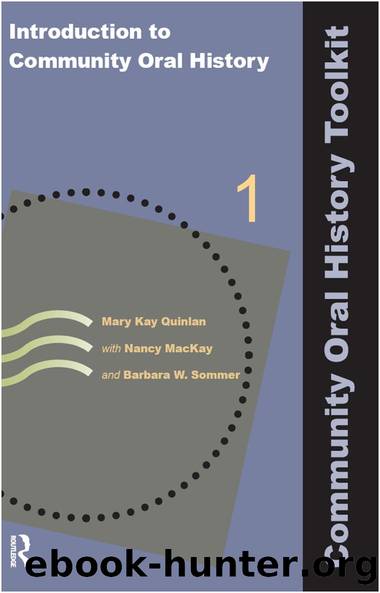
Author:Mary Kay Quinlan, Nancy MacKay, Barbara W Sommer [Mary Kay Quinlan, Nancy MacKay, Barbara W Sommer]
Language: eng
Format: epub
Tags: History, General, Historiography, Language Arts & Disciplines, Communication Studies, Social Science, Anthropology
ISBN: 9781315426044
Google: GsJmDAAAQBAJ
Publisher: Routledge
Published: 2016-06-16T16:17:19+00:00
Sample Agreement Forms
This series of forms consists of sample agreements commonly used in oral history projects. The forms will guide you developing your own agreements, but remember, they are samples only. Each letter of agreement should be adapted to the specific project.
Legal Release Agreement
(See p. 86 for sample; download a template at www.LCoastPress.com)
This is the most important form in an oral history project. Without a Legal Release Agreement signed by the interviewee and the interviewer, an oral history interview may not legally be used in any way. Every Legal Release agreement should be customized for the particular circumstances of the project. We offer this as a sample. Have a separate agreement signed for every interview. See Volumes 2, 3, 4, and 5.
Legal Release Agreement (Restrictions)
(See p. 87 for sample; download a template at www.LCoastPress.com)
Occasionally, special cases concerning the interview come up that arenât covered in the generic legal release agreement. Examples are an intervieweeâs wish that the interview be restricted from public view for a certain amount of time, a request that his name be withheld, and a request that the interview not be made available on the Internet. Though there are many legitimate reasons for placing restrictions on an interview, they should be the exception rather than the rule and the project director should consult with the repository contact as well as a legal advisor before agreeing to one or more restrictions. Adapt this form to specify the restrictions placed on the interview. See Volumes 3 and 5.
Letter of Agreement for Repository
(See p. 88 for sample; download a template at www.LCoastPress.com)
This agreement spells out the relationship between the oral history project and the repository. It is very important to specify, in writing, which agency is responsible for which tasks, for the expenses incurred, and for maintaining the timeframe. See Volumes 2 and 3.
Letter of Agreement for Interviewer
(See p. 89 for sample; download a template at www.LCoastPress.com)
A written agreement such as this emphasizes the professional nature of being an interviewer, and also serves are a backup in case there are misunderstandings. See Volumes 2 and 3.
Letter of Agreement for Transcriber
(See p. 90 for sample; download a template at www.LCoastPress.com)
This letter clarifies the expectations for the transcriber. Usually a single letter for each project transcriber is sufficient. See Volumes 2, 3, and 5.
Project Design Statement
This form helps organize ideas for an oral history project and create a road-map for moving forward. Begin your project with this form and use it as a planning tool. See Volumes 2, 3, and 5.
Download
This site does not store any files on its server. We only index and link to content provided by other sites. Please contact the content providers to delete copyright contents if any and email us, we'll remove relevant links or contents immediately.
Spell It Out by David Crystal(36110)
Life for Me Ain't Been No Crystal Stair by Susan Sheehan(35804)
Cecilia; Or, Memoirs of an Heiress — Volume 1 by Fanny Burney(32549)
Cecilia; Or, Memoirs of an Heiress — Volume 2 by Fanny Burney(31948)
Cecilia; Or, Memoirs of an Heiress — Volume 3 by Fanny Burney(31932)
The Great Music City by Andrea Baker(31917)
Professional Troublemaker by Luvvie Ajayi Jones(29651)
The Secret History by Donna Tartt(19058)
We're Going to Need More Wine by Gabrielle Union(19035)
Twilight of the Idols With the Antichrist and Ecce Homo by Friedrich Nietzsche(18626)
All the Missing Girls by Megan Miranda(15962)
Cat's cradle by Kurt Vonnegut(15339)
Pimp by Iceberg Slim(14489)
Bombshells: Glamour Girls of a Lifetime by Sullivan Steve(14058)
For the Love of Europe by Rick Steves(13948)
Talking to Strangers by Malcolm Gladwell(13350)
Norse Mythology by Gaiman Neil(13349)
Fifty Shades Freed by E L James(13233)
The Social Justice Warrior Handbook by Lisa De Pasquale(12187)
